
Electricity Kit AC Theory Manufacturer,Supplier and Exporter in India
.jpg)
Product Code : SCL-PLE-11864
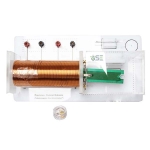
The EElectricity Kit AC Theory by Scientifc Equipment is an educational electricity and electronics laboratory kit designed to demonstrate alternating current principles, AC waveform concepts, voltage, current, resistance, frequency, phase, impedance, transformers, and basic AC circuit behaviour. It is suitable for school physics laboratories, college science labs, electronics classrooms, STEM labs, teacher demonstrations, and supervised student experiments.
This AC theory kit helps students understand how alternating current differs from direct current and how AC circuits behave with components such as resistors, lamps, coils, capacitors, switches, meters, and transformers depending on product configuration. It supports practical learning of safe low-voltage AC experiments, circuit connection, measurement, observation, and electrical theory.
Product Description
Alternating current is an electric current that changes direction periodically. The EElectricity Kit AC Theory is designed to provide students with a hands-on way to explore AC concepts using safe educational circuit components. Students can observe the effect of AC supply on lamps, coils, meters, and other components while learning about frequency, voltage, current flow, and circuit response.
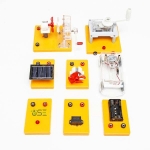
The Scientifc Equipment EElectricity Kit AC Theory may include component modules, connecting leads, lamps, resistors, capacitors, coils, switches, meter connections, transformer demonstration parts, plug-in boards, activity sheets, and storage accessories depending on product configuration. It is designed for supervised educational and laboratory demonstration use only.
Key Features
- Educational kit for teaching alternating current theory and basic AC circuits.
- Useful for demonstrating voltage, current, resistance, frequency, impedance, and phase concepts.
- Supports safe low-voltage AC demonstrations in supervised laboratory conditions.
- Can be used to compare AC and DC circuit behaviour depending on setup.
- Suitable for physics, electronics, electrical science, and STEM lessons.
- May include modular components for easy circuit building depending on product configuration.
- Helps students develop practical circuit connection and measurement skills.
- Encourages observation, prediction, calculation, troubleshooting, and scientific reasoning.
- Designed for supervised educational laboratory use only.
Product Specifications
|
Product Name |
EElectricity Kit AC Theory |
|
Brand |
Scientifc Equipment |
|
Product Type |
Educational AC Theory and Electricity Demonstration Kit |
|
Application |
AC Circuit Demonstration, Alternating Current Theory, Voltage and Current Study, Frequency Activity, Impedance Demonstration, Transformer Practical, STEM Learning, and Classroom Teaching |
|
Working Principle |
Alternating Current Changes Direction Periodically and Produces Different Circuit Responses Depending on Resistance, Inductance, Capacitance, Frequency, and Load Conditions |
|
Possible Components |
Resistor Modules, Lamp Holders, Switches, Capacitors, Coils, Transformer Unit, Connecting Leads, Plug-In Board, Terminals, Meters or Meter Connections, Activity Sheet, and Storage Box Depending on Product Configuration |
|
Possible Material |
Plastic or Acrylic Base, Metal Terminals, Copper Coil, Insulated Wires, Electronic Components, Lamp Holders, Switches, and Educational-Grade Laboratory Materials Depending on Model Design |
|
Power Requirement |
Suitable Low-Voltage AC Power Supply Depending on Kit Rating and Product Configuration |
|
Measurement Type |
Voltage, Current, Resistance, Frequency, Phase, Impedance, Lamp Brightness, Transformer Output, and Circuit Response Depending on Experiment Setup |
|
Compatible Accessories |
Low-Voltage AC Power Supply, Multimeter, Voltmeter, Ammeter, Oscilloscope, Signal Generator, Connecting Leads, Graph Paper, Activity Sheet, and Electrical Lab Accessories |
|
Educational Use |
Physics Lesson, Electronics Practical, Electrical Circuit Demonstration, AC Theory Activity, STEM Project, and Student Laboratory Work |
|
Suitable For |
Schools, Colleges, Physics Laboratories, Electronics Labs, Science Rooms, STEM Labs, Teacher Training Centers, and Educational Institutions |
|
Learning Topics |
Alternating Current, AC Voltage, AC Current, Frequency, Phase, Resistance, Capacitance, Inductance, Impedance, Transformer Action, Waveform, and Electrical Circuits |
|
Operation |
Low-Voltage Circuit Connection, Component Testing, AC Response Observation, Meter Reading, Circuit Comparison, Data Recording, and Supervised Laboratory Demonstration |
|
Important Note |
For Educational and Laboratory Demonstration Use Only; Component List, Power Rating, Circuit Modules, Accessories, Measurement Range, and Construction Depend on Product Configuration |
How to Use
- Place the EElectricity Kit AC Theory on a stable, clean, dry, and level laboratory bench.
- Inspect all modules, terminals, switches, leads, lamps, coils, capacitors, and accessories before use.
- Ensure the low-voltage AC power supply is switched off before making any circuit connections.
- Select the required experiment from the activity sheet or teacher’s demonstration plan.
- Connect the circuit using insulated leads and the correct component modules.
- Connect meters such as voltmeter, ammeter, or multimeter if measurements are required.
- Switch on the power supply at the recommended low-voltage setting.
- Observe the circuit response, lamp brightness, meter reading, or waveform depending on the experiment.
- Compare different components such as resistors, capacitors, coils, or transformer sections where applicable.
- Record readings and observations in a practical notebook or activity sheet.
- Switch off the power before changing components, leads, or circuit arrangements.
- After use, disconnect all connections, organize components, and store the kit safely.
Safety and Handling Instructions
- Use only under teacher, laboratory instructor, or trained adult supervision.
- Use only the recommended low-voltage AC power supply for educational experiments.
- Do not connect the kit directly to mains electricity.
- Switch off the power supply before changing connections or replacing components.
- Do not touch exposed terminals, metal contacts, or component leads while the circuit is powered.
- Do not exceed the rated voltage or current of the kit components.
- Capacitors, coils, and lamps may become warm during use; allow them to cool before handling.
- Discharge capacitors safely before touching or rearranging capacitor circuits where applicable.
- Do not use damaged wires, cracked modules, loose terminals, burnt components, or faulty power supplies.
- Keep the kit away from water, chemicals, flames, heat, dust, and damp surfaces.
- Store all electrical components in a clean, dry, and protective place after use.
Educational Applications
- Demonstrating alternating current theory in physics and electronics lessons.
- Comparing AC and DC circuit behaviour.
- Studying voltage, current, resistance, and frequency in AC circuits.
- Introducing impedance, inductance, capacitance, and phase difference concepts.
- Explaining transformer action and basic AC power transfer.
- Supporting meter reading, circuit building, and waveform observation activities.
- Useful for STEM projects, practical exams, and teacher-led demonstrations.
- Encouraging observation, calculation, troubleshooting, comparison, and scientific reasoning.
Why Choose Scientifc Equipment EElectricity Kit AC Theory?
The Scientifc Equipment EElectricity Kit AC Theory provides a structured and practical way to teach alternating current concepts through hands-on circuit experiments. By using low-voltage educational components, students can safely observe AC behaviour, compare circuit responses, and understand the principles used in electrical systems and electronics.
FAQ
- What is the EElectricity Kit AC Theory used for?
It is used to demonstrate alternating current principles, AC circuits, voltage, current, resistance, frequency, impedance, transformer action, and basic electrical theory.
- Is this kit suitable for school physics laboratories?
Yes, it is suitable for school physics labs, college science labs, electronics classrooms, STEM labs, teacher demonstrations, and supervised student practicals.
- What is the difference between AC and DC?
AC changes direction periodically, while DC flows in one direction. This kit helps students observe AC circuit behaviour through practical demonstrations.
- Does the kit require a power supply?
Yes, it generally requires a suitable low-voltage AC power supply depending on the kit rating and product configuration.
- Can students measure voltage and current with this kit?
Yes, students can use compatible voltmeters, ammeters, or multimeters to measure circuit values under teacher guidance.
- Can this kit be connected to mains electricity?
No, the kit must not be connected directly to mains electricity. It should be used only with the recommended low-voltage educational power source.
- Can students use the kit independently?
Students should use the kit only under teacher or laboratory instructor supervision because it involves electrical circuits, meters, and component connections.
- How should the EElectricity Kit AC Theory be stored?
Store all components, leads, modules, and accessories in a clean, dry, and protective box away from moisture, heat, dust, chemicals, impact, and rough handling.
SEO Keywords
EElectricity Kit AC Theory, Scientifc Equipment AC Theory Kit, electricity kit AC theory, alternating current demonstration kit, school physics AC circuit kit, AC electricity apparatus, STEM electrical circuit kit, electronics teaching kit, impedance and frequency demonstration, transformer theory kit, low voltage AC experiment kit, educational AC circuit apparatus.
SEO Meta Title
EElectricity Kit AC Theory – Scientifc Equipment
SEO Meta Description
Buy EElectricity Kit AC Theory by Scientifc Equipment for school physics labs, AC circuit demonstrations, alternating current lessons, transformer activities, electronics practicals, STEM learning, and supervised classroom experiments.
Google E-E-A-T Focused Content
This product content is prepared to support teachers, school buyers, laboratory suppliers, physics educators, electronics instructors, STEM coordinators, lab technicians, students, and educational institutions with clear product information, practical specifications, usage guidance, safety instructions, and helpful FAQs. The content focuses on accurate educational AC electricity applications, supervised low-voltage circuit demonstrations, safe component handling, alternating current theory learning, transformer and impedance observation, and trustworthy product guidance while clearly stating that the product is for educational and laboratory demonstration use only.
.jpg)
.jpg)
.jpg)
.jpg)
.jpg)
